Conductor
Metal, stranding, and gauge. Write 18 AWG, 20 AWG, or 22 AWG only when the circuit needs that size. A power pair and a signal pair can differ inside one assembly.
QUESTION-LED PLANNER
Use this planner before you ask wire harness and cable assembly manufacturers for numbers. The point is to see which choices are still open. LinkScope Sourcing 28 will not fill a blank with a guessed construction.
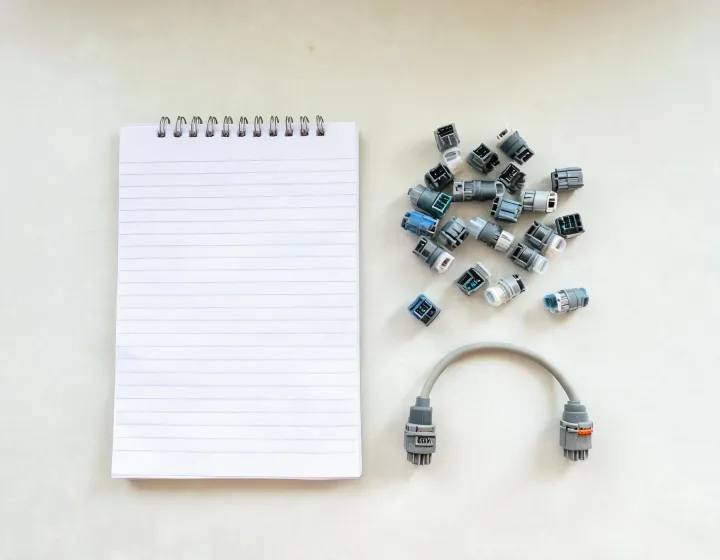
Metal, stranding, and gauge. Write 18 AWG, 20 AWG, or 22 AWG only when the circuit needs that size. A power pair and a signal pair can differ inside one assembly.
Overmold, adhesive boot, or gasketed housing. If you write IP67, ask the factory which condition it will cite. A common discussion point is 1 m for 30 minutes. That sentence is a question, not a test this desk ran.
Family, insert, keying, plating, and crimp versus solder. Mating-cycle rating comes from the housing datasheet. Do not copy a 500-cycle figure from a different series.
Braid, foil, or none. Jacket compound and a bend-radius question for the finished length. Return loss and impedance stay on coax legs. Insertion loss stays on fiber legs.
Many single conductors, breaks, and labels. Labor is in the crimps and the routing. A quote that prices only the cable reel misses the breakout.
One cable with terminated ends. Labor is in the strip, the connector, and the test of that length. Core count and jacket rating must match the cable callout, not a loose-wire list.
Accept a substitute only when gauge, core count, plating, seal method, and length tolerance still match the open questions you marked mandatory. A photo with the same connector shell is not that match. Wavelength and optical budget do not transfer onto a copper harness. Host compatibility for a powered device still needs the exact voltage and the connector pin that carries it.
An OEM drawing keeps the pin table yours. A compatible proposal can add plants and can also move 22 AWG to 20 AWG or 50 ohm to 75 ohm. New contacts are easier to tie to a plating callout. Refurbished contacts can fill a legacy shell when the drawing allows them, and they need a date code.
Write the figures you know: 18 AWG, 20 AWG, or 22 AWG; IP67 as 1 m for 30 minutes if you want that condition discussed; hipot at 500 VDC or 1000 VDC; mating cycles at 100 or 500; VSWR and gain with a frequency range such as 698-2700 MHz; insertion loss and return loss on the coax or fiber leg; Power over Ethernet at 15 W or 30 W on the powered pairs. Dispersion, receiver sensitivity, transmit power, measurement accuracy, and calibration traceability stay on the host or the meter. Switching capacity and forwarding rate do not describe this assembly.
Standards pages, including TIA cabling overviews checked as question sources, do not replace the purchased document or the supplier datasheet. Equipment-authorization rules apply to the radio or the host when those rules apply. They are not inherited by a passive harness because it plugs in. Keep the card names as labels and move the finished packet to the brief.
When the open questions are marked, send quantity, destination, timing, and an optional budget with currency and per-assembly or whole-order basis. High-end, mid-range, budget, or undecided remains your preference.
QUALIFIED BUSINESS BUYERS
Compare quotations from up to 3 factories after the harness construction is written down.
Eligibility applies to qualified business buyers and is confirmed after we review your product, quantity, destination, and sourcing requirements.